Hindus all over worship Lord satyanarayana in their homes. Lord
satyanarayana is an avatar of Lord Vishnu himself. Satya means truth and
Narayana means the Absolute. This pooja is usually performed on any
auspicious occasion like after a wedding in the family, moving into a
new house etc. Ideally this pooja should be performed on a new moon day
in the evening after fasting the whole day. This is the Satyanarayana
Vratham or Vratha.
In this pooja, Lord Satyanarayana is worshipped by devotees by
reciting the story of His greatness which is explained in five chapters
with five different stories. These are known as Shri Satyanarayana Katha.
The pooja starts with the lighting of the lamp and prayers are
offered to Lord Ganesha, Goddess Lakshmi, Lord Shiva and Goddess Parvati,
the Sun God, the nine planets and Ashtadikpaalakas and Lord Indra. After
completing the pooja the prasad which is prepared from sooji, ghee and
sugar is distributed among family and friends who are invited to take
part in the pooja and seek the Lord's blessings.
Satyanarayana Story
Once, Shownak and 88,000 other rishis assembled at the forest
Naimisharanya and asked Maharishi Sootha, the narrator of the Puranas,
"Oh! Maharishi, please tell us how mankind can attain salvation?"
Maharishi Sootha answered: "Once Narada Muni asked Lord Vishnu, the
consort of Lakshmi, the same question. I will tell you what Lord Vishnu
told Narada, so listen carefully."
Once, Narada, during one of his sojourns to the various worlds, came to
earth. There he saw the people suffering as a result of their past
deeds. To alleviate their sufferings and bring them salvation, Narada
traveled to Vishnu Loka. There he found Lord Vishnu adorned with ‘Sanhka’,
‘Chakra’, ‘Gadha’ and Lotus in his four hands and a Garland around his
neck. Narada spoke humbly: "Oh, Supreme Lord, the savior of the
destitute and the troubled, I surrender at thy feet." Asked Lord Vishnu:
"Narada, why have you come here? Tell me what you want and I would
fulfill your wishes." To which Narada replied, "Oh, Bhagavan, people on
earth are suffering in many ways as a result of their own past sinful
deeds. Please bestow thy grace and reveal to me as to how they can be
helped." Lord Vishnu replied, "Oh, Narada, mankind can rid itself of all
its sorrows by performing a puja called SATYANARAYANA PUJA. This puja
when performed according to religious rites will bring happiness, peace
of mind and wealth in this life and salvation beyond." On hearing this,
Narada was filled with joy and addressed Lord Vishnu thus: "Oh, Lord, in
your infinite grace, please tell me the details of the puja that you
just mentioned, how and when to perform it and who has performed it
before." Lord Vishnu answered: "This puja can be performed any month on
a full-moon day. One must gather his friends and relatives perform the
puja with devotion and offer fruits, ghee, milk, curd, butter, wheat
flour, sugar and honey to the god. After the puja is over, he must read
the Satyanarayana Katha and distribute prasad to everybody. If the puja
is thus performed, it will bring fulfillment of one's wishes.
Particularly, in the Kaliyuga, this puja brings contentment."
CHAPTER 2
Maharishi Sootha continued addressing the assembled rishis, "Oh Rishis,
I will tell you who all have observed the Satyanarayana puja in the
past. Once, there lived a very poor Brahmin in the beautiful city of
Kasi. Plagued by acute hunger, he used to wander about here and there
every day. Lord Vishnu took the form of an old man, appeared before the
poor Brahmin and asked: "Friend, why are you wandering aimlessly?" The
poor Brahmin replied, "Sir, I am a very poor man. Unable to bear the
pangs of hunger, I beg for alms. Sir, if you know a way out of this
misery, please tell me." Whereupon, Lord Vishnu, who was in the guise of
an old man, replied, "Oh, Brahmin, Lord Satyanarayana grants his
devotee's wishes and removes their sorrows. So you should perform his
Puja and reap its benefits." Lord Vishnu then explained the details of
the Satyanarayana Vratha to the poor Brahmin and disappeared.
The poor Brahmin immediately resolved to perform the puja. After a
sleepless night, he got up early in the morning and went to beg for
alms, his mind fixed on only one thing, namely the puja. That day he got
a lot of money with which he bought fruits and milk, curd and honey and
performed the puja with his relatives and friends. With Lord
Satyanrayana's grace, he shed his poverty and lived a contented life.
Every month on the full moon day he performed and finally attained
Moksha (salvation).
Maharishi Sootha thus told the assembled rishis the story which
originally was narrated by Lord Vishnu to Narada Muni.
The rishis again addressed Maharishi Sootha: "Oh, the Great One, please
tell us in detail who else performed the puja."
Maharishi Sootha continued: One day when the poor Brahmin from Kasi was
observing the Satyanarayana Vratha, a wood-cutter entered his house and
asked for water. Seeing the Brahmin perform the puja, the wood-cutter
inquired what the puja was about and what, good it would bring. The
Brahmin, who had been bestowed with Lord Narayana's grace, spoke: "This
is called Satyanarayana Vratha. Anyone who observes this Vratha will get
all riches. 1 myself have been bestowed with wealth." The wood-culler
was delighted to hear this. He learned the proper way to perform the
puja, ate the prasad that was offered and went his way.
With Lord Satyanarayana in his mind, the wood-cutter resolved that he
would observe the Vratha with whatever he was going to make by selling
firewood that day. He went to that part of the city where rich people
lived, sold the firewood and made twice the normal profit. Pleased with
his luck the wood-cutter bought bananas, sugar, ghee,-milk, curd, honey
and wheat flour and performed the Satyanarayana puja with his friends
and relatives. By Lord Narayana's grace, he acquired enormous wealth and
lived comfortably and attained moksha (salvation).
CHAPTER 3
Maharishi Sootha continued: "Oh, best of ascetics, I will now tell you
the story further. In the olden days there lived a wise king by the name
Ulkamukha. He had mastered all his senses and always spoke truth. He
used to go to the temple every day and give gifts to the Brahmins. His
lotus-faced wife was a pure and pious woman. One day, the royal couple
was performing the Satyanarayana puja at the banks of the river
Bhadrasheela. At that time a merchant called Sadhu sailed by. Seeing the
King perform some puja, Sadhu stopped his boat, got off and addressed
the king humbly: "Oh, King, would you kindly tell me what you are doing
with such devotion and concentration?" The King replied, "Oh, Sadhu, I
have no children. In order that I may be blessed with children, I am
worshipping the Almighty Lord Satyanaryana."
On hearing this Sadhu spoke humbly: "Oh, King, please tell me how to
perform the puja. I would like to observe the Vratha, as I too have no
children." The King told him all the details. Sadhu returned home and
with great joy told his wife that they should perform Satyanarayana puja
which will fulfill their desire to have children. He then resolved to
perform the puja after the child was born.
Then by the divine grace, Sadhu's wife Leelavathi conceived and in due
course, a beautiful daughter was born to them. They named the child
Kalavathi.
One day, Leelavathi reminded her husband of his promise to perform puja.
Sadhu told his wife that he would do the puja at the time of his
daughter's wedding and got busy with his work.
In the meantime, Kalavathi grew up and blossomed into a lovely girl
Sadhu sent out messengers to find a suitable bridegroom for his
daughter. One of his messengers found a good-natured and handsome boy in
a Vaishya family from Kaanchana Nagar. Sadhu found the boy to be a
suitable match for Kalavathi and celebrated his daughter's wedding with
great pomp and show. But Sadhu completely forgot about the Satyanarayana
puja and thus angered Lord Satyanarayana.
Then, one day Sadhu went on a business trip with his son-in-law. He
stopped to trade at Ratnapura that was ruled by king Chandraketu. Lord
Satyanarayana placed a curse on Sadhu.
One day, some thieves robbed the king's treasury and were running away.
The king's soldiers followed them in hot pursuit. The frightened thieves
threw all the things they had robbed near Sadhu and escaped. Finding the
king's treasure near Sadhu and his son-in-law, the king's soldiers
arrested them and brought them before the king. The king ordered them to
be chained and thrown into prison. Because of Lord Narayana's Maya,
nobody even listened to what Sadhu had to say in his defense. King
Chandraketu also confiscated all their merchandise.
Lord Narayana's curse did not spare Sadhu's wife. Some robbers broke
into her house and Leelavathi lost everything.
One day, Kalavathi was very hungry and ran out of the house. She
wandered here and there and stopped at a house where Satyanarayana puja
was being performed. She stayed at that place until the puja was
finished and ate the prasad that was offered. When she reached home, it
was late night. Leelavathi asked her where she had been. Kalavathi told
her mother that she was listening to Satyanarayana Katha in somebody's
House. Leelavathi at once remembered her husband's promise to perform
the puja and resolved to observe Satyanarayana Vratha herself. She
collected all her relatives and friends and prayed to Lord Satyanarayana
to forgive their sins.
Lord Satyanarayana was pleased with Leelavathi's prayers. He appeared
before King Chandraketu in his dream and told him to release the two
merchants from prison as they were not the real thieves. If the king
failed to do so, Lord Narayana warned that his kingdom, wealth and
children would all be destroyed.
Next morning, the king told his counselors about his dream and ordered
Sadhu and his son-in-law to be released. The latter were frightened and
stood before the king with bowed heads. The king talked to them gently
and said, "You two have suffered a great deal because of your fate, but
there is nothing to fear," The king returned their merchandise, gave
them new clothes and lots of gifts and bade them good-bye.
CHAPTER 4
Sadhu and son-in-law loaded their boat with the riches given to them by
the king and sailed homeward. Lord Satyanarayana wanted to test the
Sadhu further. He took the form of an ascetic with a trident, appeared
before Sadhu and asked him what he was carrying in his boat. Without
realizing that the ascetic was indeed Lord Narayana in disguise, Sadhu
laughed mockingly and said, "You Brahmin, were you thinking of stealing
my things? We do not have any valuables in the boat except vessels."
Whereupon Lord Natyarana replied, "Oh Sadhu, so be it." The ascetic then
departed in great haste and stood by the seashore.
When Sadhu went into his boat, he discovered to his horror that the boat
was filled with vessels just as he had falsely told the ascetic. Sadhu
swooned at the sight but he was revived by his son-in-law who spoke:
"This must be the curse of the ascetic. He must be a mystic. Let's go to
him and ask his forgiveness." The two merchants then went to the
seashore where the ascetic was meditating. They fell at his feet and
repeatedly begged for his forgiveness.
Pleased by Sadhu's devotion, the Lord said, "Sadhu, do not weep. You
suffer because you have broken your promise time and again." On hearing
this, Sadhu prayed to God, "Oh Lord, even Brahma and other Devas
drowned in your Maya, cannot comprehend your form completely. How can
I, with my limited knowledge, comprehend your various forms? I pray
within my limited knowledge. Please show me your true form and bless
me."
Upon hearing his prayer, God was pleased and granted his wishes,
restoring his merchandise in the boat, and disappeared. The two
merchants then joyfully sailed homeward. On reaching their hometown,
they sent a messenger to their wives to inform them of their safe
arrival.
At that time, Leelavathi and Kalavathi were performing Satyanarayana
puja. Leelavathi quickly finished the puja and asked her daughter to do
so. She then hurried to the seashore to meet her husband. Kalavathi, in
her eagerness to meet her husband, forgot to eat the prasad and rushed
to the seashore. This action of hers angered Lord Satyanarayana. He
caused the ship and her husband to drown in the sea.
Not finding her husband, Kalavathi started weeping. All were
wonderstruck and frightened. Sadhu was at a loss to know what to do.
Thinking that it was Lord Narayana's Maya, he announced to that he would
perform Satyanarayana puja and prayed to Lord again and again. At this,
Lord Satyanarayana, the savior of the sinners, was very pleased and
said, "Oh Sadhu, your daughter did not eat the prasad in her haste to
see her husband, so I made him and the boat disappear. Let her go home,
take the prasad and return." On hearing this, Kalavathi rushed and took
the prasad. When she returned to the seashore, she found to her joy her
husband and the boat. Then Sadhu returned home happily with his
relatives and performed the Satyanarayana puja every full moon day. With
God's grace, he enjoyed all the comforts in this world and finally
attained salvation.
CHPATER 5
Maharishi Sootha continued: "Once there was a king called Thungadhwaja
who underwent a lot of misery after refusing the Satyanarayana prasad."
One day, after hunting, he was resting under a shady tree. Some cowherds
were happily performing Satyanarayana puja nearby. The King, in his
vanity, refused the prasad they offered. When he reached his palace, he
found that his kingdom, his 100 sons, his wealth and everything was
destroyed. Then it occurred to him that Lord Satyanarayana was probably
angry with him. He went back to the cowherds, prostrated himself before
Lord Satyanarayana and performed the puja with great devotion. Lord
Satyanarayana showered His blessings and the King regained everything he
had lost earlier. He lived happily and reached Vaikuntha after death.
Maharishi Sootha said, "Oh holy men, I have narrated to you the
Satyanaryana Katha which was originally told by Lord Vishnu to Narada
Muni. By observing this Vratha, mankind can attain salvation. In this
Kaliyuga, observance of the Vratha can lead to gratification of one's,
wishes." Thus ended the narration of Maharishi Sootha after which
Shownak and other rishis returned to their respective places.
-oOo-
Note: This Puja consists of two
distinct parts. In the first part, pujas are performed to Lord Ganesha,
to Navagraha, to Ashtadikpalaka, to Panchalokapalakas and to
Satyanaryana. The second part consists of recital of the above stories
by the devotees and distribution of prasad. Temple can perform this Puja
on every full-moon day for a year on your behalf, and mail you the
prasad.
Surya

Lord Surya is the ruler of navgraha (nine
planets) that rotate around him in Hindu astrology. It is also known as
Bhanu, Grahapati, Bhaskar, Arka, Savita, Mitra, Pusha, Divakar, Vivasvat,
Ravi and Aitya. Lord Surya is the son of Sage Kashyap and Aditi and is
described as 'Aharpati' means Lord of the day and 'Jagat Chakshu' means
Eye of the world. The surya rays living beings and nurture life and
nourish. Thus, Lord Surya is described as 'time-giver' and 'life-giver'
or 'Pranadata'.
He is the protector of the east and sanctifies
his devotees with prosperity, fame and good health. Sunday is the ruling
day of Lord Surya. He leads red ruby, gold and metal. Lord Surya is the
leader of solar god and is one of the Adityas. He has arms and hair of
gold. The celestial body is the sun and is visible in the sky. He is
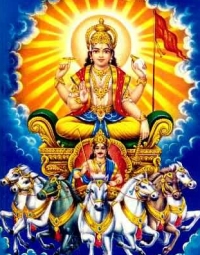
described as a red man with 3 eyes and 4 arms, riding into a one wheeled
chariot pulled by 7 horses similar to the rainbow colors.
Lord Sun is the most powerful and majestic
visible God. The Sun God has also played important role of Master Guru
for many Gods, number of Devotees and Seers. In Hindu religion, symbol
of Surya is considered as one of the positive signs.
In Hindu religion, the Gayatri hymn is also
associated by the Lord Surya. Aditya Hridayam is another mantra
associated with the son God, Surya. Shri Surya Ashtottar Shatnamavali
has 108 names of Surya. Shri Surya Sahasranam is one thousand names and
are describing one thousand qualities of Bhaskara. All names of Lord
Surya refer to a quality of awareness.
Lord Surya is the exact source of life. According
to Vedic books said that Lord Surya is the light god. Lord Surya
symbolizes the Sun God. Lord Surya is regarded as the visible type of
dev. It could be seen every day. The Sun god is considered as an aspect
of Vishnu and Shiva by Vaishnavas and Shaivites. Lord Surya is also
known as Surya Narayana. Surya is also recognized as one of the 8 types
of Lord Mahadeva, named the Astamurti. He is the wisdom and excellence
devata.
Surya makes day and night, offer energy to all
living beings and rids them for ailments and lethargy. He symbolizes
during the day of Lord Brahma, noon at Lord Shiva and in the evening of
Lord Vishnu. The Sun god is also symbolized by a golden wheel or still
the open flower of a lotus. The most common symbolization is in the type
of Swastika.
Lord Surya helps one gain his eyesight and second
gain his surya namaskar will strengthen one's bones, wealth, long life,
progeny, cure illness and good-health. Lord Surya is the reason for
rain-fall advantaging the world and is the lord of Leo in the Zodiac. In
zodiac, Sun occupies the most famous place in the middle. Lord Surya
stays in each Rasi one month and takes twelve months to complete a
circular of twelve Rasis.
Lord Surya Temple
Temple of Lord Surya are all the across the
country. Suryanarayana temple is located at Tamil Nadu and is popularly
known as Suryanar-Koli. It is about 3 km from the Aduturai railway
station on the Southern Railway major line from Madras - Thanjavur.
Konark is also another temple of Lord Surya at Orissa in Buguda of the
Ganjam District. Konark is called as Biranchi Narayan temple in Gujarat,
the sun temple was created by Bhimdev of Solanki dynasty and Arasavalli
located at Andhra Pradesh.

